What Trump’s Psychedelic Executive Order Could Mean for Therapy, Addiction, and the Future in Canada
Explore how Trump’s new executive order is accelerating psychedelic therapy research, including MDMA for PTSD and ibogaine for addiction, and what it could mean for Canada.
4/21/20266 min read

Psychedelic Therapy Is Moving Fast in 2026. Here’s What the Latest U.S. Policy Shift Means for MDMA, Ibogaine, and Canada
Over the past couple of days, something has shifted in the world of psychedelic therapy.
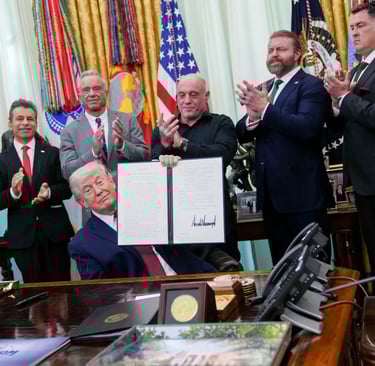
If you have been paying attention, you may have seen headlines about a new executive order from Donald Trump aimed at accelerating research and access to treatments for serious mental health conditions. Psychedelics are not the only focus, but they are clearly part of the conversation now. For a long time, this field has lived on the edges of medicine. Quiet research, small trials, underground practice, and slow-moving regulatory systems. Now it feels like that edge is starting to move inward. For those of us working in therapy, especially in trauma and addiction, this moment carries weight. Not because policy alone changes practice, but because it reflects something deeper. The science has been building for years, and it is starting to reach a point where it can no longer be ignored.
The Research Did Not Start Here
This moment is easy to misunderstand if it is viewed as sudden. It is not.
Organizations like the Multidisciplinary Association for Psychedelic Studies have spent decades building a foundation that is only now becoming visible to the broader public. Their work with MDMA-assisted therapy for PTSD has quietly produced some of the most compelling clinical outcomes in modern mental health treatment.
A Phase 3 trial published in Nature Medicine showed that after a structured course of MDMA-assisted therapy, a significant majority of participants no longer met criteria for PTSD. What stands out in that research is not just symptom reduction. It is the depth of change. People who had been living with chronic trauma for years, sometimes decades, experienced shifts that traditional treatments had not been able to reach.
There have been regulatory complications along the way, and approval has not been straightforward. But that is part of the process when something challenges the existing model of treatment. What matters is that the data continues to accumulate.
MDMA Therapy for PTSD Is Not What People Think
There is still a common misconception that MDMA therapy is about the substance itself. It is not.
MDMA appears to create a psychological and neurological state where trauma can be processed differently. Research suggests reduced activity in fear-based brain circuits and increased emotional openness. Clients are often able to approach painful memories without becoming overwhelmed in the same way they might in traditional exposure-based therapies.
But the outcome does not come from the substance alone. It comes from the structure around it.
The preparation sessions, the therapeutic relationship, and especially the integration work afterward are what determine whether the experience leads to lasting change. Without that structure, even a powerful experience can remain unresolved or confusing.
This is where psychotherapy becomes central, not optional.
Ibogaine and Addiction Treatment Are Quietly Re-Entering the Conversation
While MDMA is moving through formal clinical pathways, ibogaine has been evolving in a different way. It has existed for years, often outside of mainstream systems, particularly in the context of opioid addiction. People have traveled internationally to access ibogaine treatment because of its reported ability to interrupt withdrawal and reduce cravings in ways that feel immediate and profound.
Now, with renewed federal attention in the U.S., ibogaine is starting to be taken more seriously at a research level.
There is growing interest in understanding how it works, both biologically and psychologically. Some early studies suggest that ibogaine interacts with multiple neurotransmitter systems, potentially resetting aspects of addiction-related neurocircuitry. At the same time, individuals often report deeply introspective experiences that bring unresolved emotional material to the surface.
At the same time, this is not a simple or risk-free intervention. There are known cardiac risks, and safe administration requires medical oversight. This is one of the reasons research and regulation matter.
But from a therapeutic perspective, what stands out is what happens after the experience.
Many people describe a period following ibogaine where patterns feel less rigid. There is a sense that something has opened. That window does not last forever, but it can be significant.
And this is where integration becomes essential.
What This Means for Psychedelic Therapy in Canada
From a Canadian perspective, this moment is less about immediate change and more about pressure building beneath the surface.
Canada has already taken cautious steps into psychedelic therapy. Through Health Canada’s Special Access Program, clinicians have been able to request substances like psilocybin and MDMA for patients with serious or treatment-resistant conditions. There have also been Section 56 exemptions granted in specific cases, particularly earlier in the pandemic era. These pathways exist, but they are limited, inconsistent, and often difficult to access. You can explore the current framework here.
What makes the recent U.S. policy shift significant is not that it changes Canadian law overnight. It does not. But it does something arguably more important. It accelerates legitimacy.
Canada tends to move in alignment with larger regulatory bodies, especially the United States. When the FDA begins to seriously consider or approve new treatments, it creates a ripple effect. Clinical data becomes harder to ignore. Public demand increases. Professional training begins to expand. Insurance conversations begin to shift.
If MDMA-assisted therapy receives broader approval in the United States, it places Canada in a familiar position. The evidence will already be established. The protocols will already be developed. The question will no longer be whether this works, but how quickly Canada is willing to implement it. And that is where things become interesting. Because Canada is already in a kind of in-between state.
There are clinicians who are trained in psychedelic integration. There are therapists who understand how to work with non-ordinary states of consciousness. There are clients who are seeking out these experiences, often traveling abroad or accessing them in non-clinical settings. What is missing is a coherent, regulated system that brings all of this together.
In practice, this means that many Canadians are already engaging with psychedelics, but the support system around those experiences is fragmented. This is where integration therapy has quietly become one of the most important entry points into the field. Even without full legalization, integration work is both ethical and accessible. Clients can process past experiences, prepare for future ones, and make sense of material that emerges. This is often where the real therapeutic work happens anyway.
At the same time, there are real barriers that will shape how quickly Canada moves forward. Healthcare in Canada is publicly funded, which creates both opportunity and constraint. On one hand, there is potential for broader accessibility if treatments are approved. On the other hand, funding decisions tend to be slower and more conservative. Psychedelic therapy, which often involves multiple sessions and extended therapeutic time, does not easily fit into existing reimbursement models.
There is also a cultural layer. Canada has generally approached psychedelics through a harm reduction and medical lens, rather than rapid commercialization. This could ultimately lead to a more cautious but potentially more ethically grounded rollout. It may also mean slower access in the short term.
Meanwhile, the research continues to grow internationally. Institutions like the Johns Hopkins Center for Psychedelic and Consciousness Research and Imperial College London’s Centre for Psychedelic Research are producing ongoing data that reinforces the therapeutic potential of these substances, particularly when combined with structured psychotherapy.
As that body of evidence expands, Canada will face increasing pressure to respond. Not just from policymakers, but from clinicians and clients who are already seeing the limitations of current treatment models for PTSD, depression, and addiction. In many ways, the question is no longer whether psychedelic therapy will become part of mainstream mental health care in Canada. The question is how it will be integrated.
Will it be slow and medically controlled, with limited access through specialized clinics?
Will it expand into private practice models with trained therapists offering structured protocols?
Or will it continue to exist in a hybrid space, where formal systems lag behind what is already happening in practice?
Right now, it is likely a combination of all three.
For therapists, this creates both responsibility and opportunity. Responsibility to stay grounded in research, ethics, and scope of practice. Opportunity to develop the skills needed to support clients in navigating experiences that are already happening, regardless of regulation.
And for clients, it creates a landscape that is still uncertain, but increasingly hopeful. Because even if policy moves slowly, the direction is becoming clearer. Psychedelic therapy is not disappearing. It is moving toward integration, both in the clinical sense and within the broader mental health system itself.
Where This Is Heading
It is still early. There are real questions that need to be addressed around safety, training, ethics, and accessibility. There is also a risk that public attention moves faster than the science. But something has shifted. Governments are starting to pay attention. Research is continuing to grow. And more people are beginning to see psychedelic therapy not as a fringe idea, but as a legitimate area of mental health treatment. If that continues, the landscape of therapy in the next decade may look very different from what it does today.
For now, the focus remains the same. Stay grounded in the research. Stay anchored in the therapeutic relationship. And support people in making sense of experiences that can be powerful, complex, and deeply human.
Ready to Take the Next Step?
If you’re feeling curious, confused, hopeful, or a little nervous, that’s usually a good sign. It means you’re approaching this thoughtfully and seriously. You don’t have to figure everything out alone.
Book a Free 15-Minute Consultation below.
We’ll talk about where you’re at, what you’re considering, and whether support feels like the right fit for you. No sales pitch. No pressure. Just honest guidance from a registered practitioner who understands the Canadian landscape in 2026. You deserve to explore this path safely. We’re here when you’re ready.
Book a Free 15 Min Consultation
We will respond in 1-2 business days to book a consultation.
psychedelicassistedtherapy@proton.me
© 2026. All rights reserved.
Important: This practice does not provide psychedelic substances.
Services are limited to psychotherapy, preparation, journey resources and integration support related to psychedelic experiences.
This website does not provide emergency services. If you are in crisis or need immediate help,
call 911 or contact Talk Suicide Canada at 1-833-456-4566.